A helmet-mounted monocular needed a range readout without moving its centre of gravity or its eye-safety class. A 6 g SPD-mini engine added distance to the reticle inside the existing housing, with no redesign of the optical path.
The manufacturer
About
ERDI designs and builds 905 nm eye-safe laser rangefinder modules — and this site is where we put that one line under the microscope.
01 / COMPANY
WHO WE ARE
One line, done properly
ERDI builds a broad laser-rangefinder catalog; this site puts the full weight on our 905 nm DToF line — the modules that disappear into night-vision sights, thermal clip-ons and UAV gimbals. One wavelength, specified without compromise.
This site focuses only on the 905 nm family, with a direct line for quotes, samples and integration questions, and support straight from the engineers who build them. For 1535 nm, 1064 nm and light-source products, visit our global site.
02 / MANUFACTURER
ERDI TECH LTD
Inside the factory
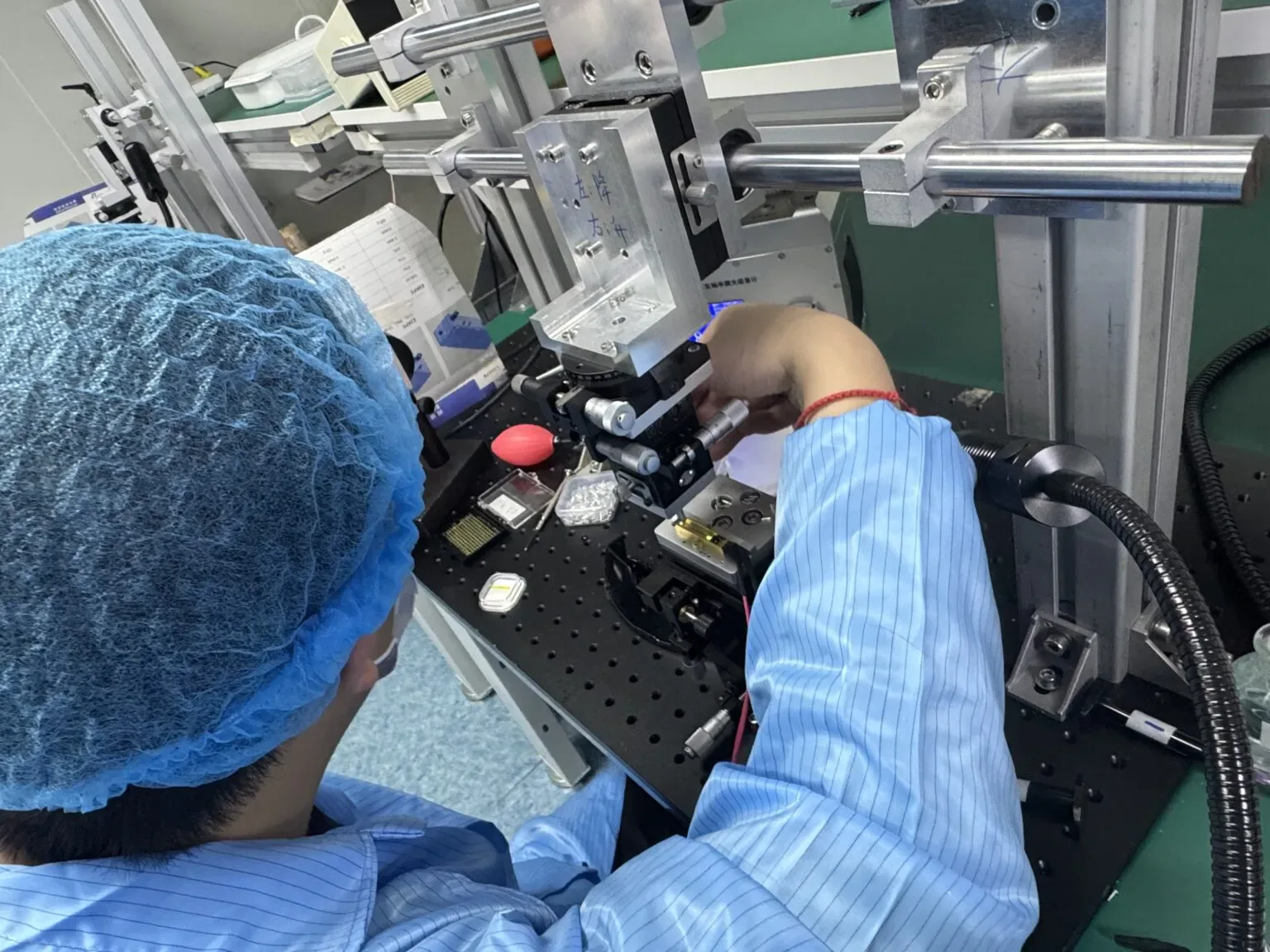
We are a Chengdu-based laser manufacturer that integrates design, R&D, production and calibration in-house.
We develop and manufacture eye-safe laser rangefinders, designators and LiDAR sensors. Production is vertically integrated — our own CNC machining, clean assembly and automated calibration — with more than 15% of revenue reinvested in R&D. That control is what lets a 12 g module hold a specified ±0.7 m accuracy.
In-houseCNC machining
Mechanical envelopes held to the datasheet, batch to batch.
CleanAssembly
Optical alignment and assembly in controlled conditions.
AutoCalibration
Output power and wavelength calibrated on every unit.
>15%Revenue to R&D
Continuous investment in ranging performance.

03 / PROCESS
DEFINE · BUDGET · BUILD · VERIFY
Six stages, one module
Every model on this site goes through the same disciplined sequence before it earns a part number — the same rigor whether it's a 6 g micro engine or the 3,000 m flagship.
- 01
Application definition
Target profile, atmosphere, required range and update rate, host optics, and the acceptance criteria the finished module must clear.
- 02
Optical link budget
Transmitter power, beam divergence, target return at the reference reflectivity, receiver aperture and detector noise margin — solved together before any metal is cut.
- 03
Electronics & firmware
Power budget, pulse timing, receiver chain, measurement-mode logic, UART framing and fault behaviour specified and simulated.
- 04
Optomechanical packaging
Mechanical datums, boresight alignment, thermal path, connector and window, sized to the model's declared service envelope.
- 05
Prototype verification
Measured range, accuracy and frequency compared against the controlled model specification across the full temperature band.
- 06
Design transfer & revision
Build controls, test instructions and a managed release record, so every unit that ships matches the unit that was verified.
Inside the build
Assembly documentary 1:24
An 84-second documentary overview of component preparation, electrical setup, optical alignment, functional verification and engineering collaboration on the ERDI production floor.
04 / APPLIED
SIX ENGINEERING CASES
Where the modules end up
Six engineering problems these 905 nm modules have been specified to solve. Described by the constraint, not the customer.
A multirotor payload needed altitude hold and target cueing that kept working as the aircraft banked and the scene changed. Adaptive frequency let the module trade update rate for reach in flight, without a mode switch from the host.
A fixed installation had to keep ranging through a full year of weather with no service access. An IP67 lens cavity and MIL-STD-810G qualification meant the sensor kept its spec through dust, rain and vibration from nearby traffic.
An AGV controller needed a distance reading it could poll continuously without babysitting the module. A UART-TTL frame simple enough for an embedded loop, at an adaptive rate up to 20 Hz, dropped straight into the existing control stack.
A handheld optic needed metre-class accuracy from a body small enough to sit in the objective bell. The flagship's 12 g, 13.5 × 25.1 × 27.8 mm envelope fit without enlarging the housing.
A mapping instrument needed readings that stayed consistent across a full day outdoors, not just a strong headline range figure. Sealed optics and a documented accuracy formula by distance band gave the integrator a number they could design to, not just quote.
05 / ASSURANCE
CERTIFICATIONS · WARRANTY
Certified and backed
Compliance and a warranty you can quote to your own customer.
ISO 9001:2015
CE
RoHS
FDA
IEC 60825-1 Class 1
MIL-STD-810G
WARRANTY
2-year coverage
First 12 months: free replacement of any verified manufacturing defect. Lifetime technical support thereafter.
SAMPLES
~1 week
Standard samples typically ship within a week of order confirmation; custom modules by design complexity.
OEM / ODM
Build to your spec
Custom mechanical envelopes, optical configurations, driver circuitry, logo engraving and packaging.
06 / PRESENCE
GLOBAL OFFICES
Where we are
- Headquarters
- No.23 Chaoyang Road, Xihe Street, Longquanyi District, Chengdu 610107, China
- United States
- Jurupa Valley, California
- Canada
- Surrey, British Columbia
- Japan
- Osaka
- Singapore
- Singapore
- Taiwan
- Taipei
Work with us
Bring your integration — we'll bring the module
Quotes, samples and OEM/ODM enquiries all start here.